Tuesday, July 2, 2013

Mango Guacamole (another 4th of July candidate!) - Vegan/GF


The Trim Tart loves guacamole, and any small twist on the regular is fun.  This mango guacamole is easy to make, delicious and healthy.  You can get creative by reserving the shells of the avocados and mango and using them for a beautiful presentation.


Mango Guacamole
Prep Time: 0 hr 25 min | Cook Time: 0 hr 0 min | Makes: 6 servings

Ingredients:

  • 3 avocados
  • 1 mango, chopped
  • 1/3 cup red onion, finely chopped
  • 1/2 cup cilantro (or chives, or mixture), chopped
  • 1/2 jalapeño pepper (more if you can take the heat!), seeded and finely chopped
  • 1 lime, seeded and finely chopped lime (2 if you like citrus flavors to be more dominant)
  • Salt & Pepper to taste


Directions:

1. Cut avocados in half; remove pit. Scoop out avocado, saving shells. Place in a medium-sized bowl.

2. Cut mango, also keeping shells.  See here for Mango Cutting 101 instructions!


 3. Chop all other ingredients and toss into bowl. Mix together with fork until blended.


Monday, July 1, 2013

Curried Rice Salad (Vegan/GF) - Perfect 4th of July side dish

I had forgotten about this recipe until this weekend when it was a potluck birthday party extravaganza with my boyfriend's family.  How could I forget this delectable, easy, healthy salad?  It's cool and refreshing - the perfect side dish for your 4th of July parties, or any time this summer.

I used everything fresh and organic and wow!  Was it ever a hit.

Curried Rice Salad
2 Tbsp coconut oil
1 medium onion, finely choppped
1/2 tsp fresh ginger, finely chopped
1 Tbsp curry powder
1 C rice (dry)
2 C water
1 tsp salt
1 C unsweetened, shredded coconut
2 ribs celery, chopped
1 medium red pepper, chopped
3/4 C raisins
1 Granny Smith apple, cored and chopped
1 C black or red grapes

Vinaigrette
1/2 C red wine vinegar
1 Tbsp garlic, minced
1 Tbsp lemon juice
1 Tbsp honey
1 Tbsp Dijon mustard
1/4 C + 2 Tbsp extra virgin olive oil
pinch of salt
2 tsp ground pepper

Garnish
1/4 C Thai sweet or Genovese basil, chopped or ribboned

Tuesday, June 18, 2013

Peach Cobbler (Vegan/Gluten-free)

I could not resist the organic peaches at the Farmer's Market on Sunday!  This is a bit of a re-do from the Easy Strawberry Granola Tart.  Today I made an organic Peach Cobbler.  I assembled it in a flash!

Peaches are so good for you!  Only 64 calories in 1 cup raw peach slices.  They are packed with Vitamin A, C, E, K, B3 (niacin), folate, calcium, magnesium, iron, and a lot potassium (8% DV).  One peach has about 2.5 g fiber, 16 g carbohydrates and 1.5 g protein.  And eat the skin!  It's good for you.

FUN FACT: Peaches and nectarines are the same species - did you know that a nectarine's smooth skin is due to a recessive allele in the fuzzy peach skin gene?  The fuzzy skin allele is dominant. 

Now onto the cobbler...
1. Preheat oven to 350 degrees.  Cut 4 medium peaches (or nectarines!) into small chunks.  I left the skin on, since it's a shame to remove and toss the valuable nutrients along with the skin.  I measured 3 Cups (~520 g or 18 oz). 

NOTE: when measuring things that are hard to smooth out in a measuring cup, it's better to use a scale and weigh it rather than try to measure a volume.  In this case, a few more pieces of peach is no big deal - but for something like chocolate chips or nuts or something more critical to the finished baked product, mass is a more accurate way to measure.


2. In a large bowl, mix peaches, 1/2 C coconut or cane sugar, 1 tsp cinnamon, 1/8 tsp cardamom, 2 Tbsp arrowroot powder (or cornstarch), and 1.5 Tbsp lemon or lime juice.


3. Pour mixed fruit into pie dish, and smooth out fruit along base of dish with spoon or spatula.


4. Mix 2 cups granola (regular or gluten-free!) with 2 Tbsp melted coconut oil.  Pour oiled granola on top of fruit in pie dish.  Smooth out until fruit completely covered.  Pop into preheated oven for 20 minutes.


5. Let cool 10-20 minutes.  Spoon into dishes and 
garnish with mint or basil leaves.  Enjoy!


Peach Cobbler (Vegan/Gluten-free)
1. Preheat oven to 350 degrees.  Cut 4 medium peaches (or nectarines!) into small chunks.  I left the skin on, since it's a shame to remove and toss the valuable nutrients along with the skin.  I measured 3 Cups (~520 g or 18 oz). 
NOTE: when measuring things that are hard to  smooth out in a measuring cup, it's better to use a scale and weigh it rather than try to measure.  In this case, a few more pieces of peach is no big deal - but for something like chocolate chips or nuts or something more critical to the finished baked product, mass is a more accurate way to measure.

2. In a large bowl, mix peaches, 1/2 C coconut or cane sugar, 1 tsp cinnamon, 1/8 tsp cardamom, 2 Tbsp arrowroot powder (or cornstarch), and 1.5 Tbsp lemon or lime juice.

3. Pour mixed fruit into pie dish, and smooth out fruit along base of dish with spoon or spatula.

4. Mix 2 cups granola (regular or gluten-free!) with 2 Tbsp melted coconut oil.  Pour oiled granola on top of fruit in pie dish.  Smooth out until fruit completely covered.  Pop into preheated oven for 20 minutes.

5. Let cool 10-20 minutes.  Spoon into dishes and garnish with mint or basil leaves.  Enjoy!

Monday, June 17, 2013

How to wash and cook Beet Greens (Sauteed Beet Green recipe)

The top greens of beets are an excellent source of carotenoids, flavonoid antioxidants, and vitamin A.  The greens actually contain these compounds in concentrations several times higher than in the roots.

So - how to deal with these beet greens?  It's easy.  If you're familiar with working with Swiss Chard, it's basically the same.  Here are step-by-step instructions for my Sauteed Beet Greens recipe!


1. Cut the leafy green part, and separate from the red stems.  Then cut the stems into 1" pieces.  Wash stem pieces and set aside.


Beet this!!

Dorky title, I know.  But it's such a glorious time of year at the farmer's markets.  Fresh and delicious EVERYTHING.  Beets are aplenty.  And they're nutritional rock stars.

Most of us are familiar with the deep red variety, and only the root part of the beet.  Some of us are familiar with them coming in cans.  But don't shy away from beets!  They are easier to cook than you might think.  There are also a few different varieties: orange-yellow (often variegated), white and red.  Whatever you do - don't toss those greens!!

Check out the stats on beets (root: cooked/boiled/roasted) - in 1/2 cup, sliced:

  • 37 calories
  • 1.7 g fiber
  • 1.4 g protein
  • Total Omega-3 fatty acids 4.3 mg
  • Total Omega-6 fatty acids 49.3 mg
  • Vitamins A, C, K, Niacin (B3) Vitamin B5 and B6, Folate (17%DV)
  • Calcium, Iron, Magnesium, Phosphorus, Potassium, Sodium, Zinc, Copper, Manganese (14% DV), Selenium


So, how to cook beets?  Easy.  Cut the stems ~1" from the root.  Wash the red root, being careful not to tear the skin.  Then put them in a pot, cover the beets with water so the level is just higher than the beets, then boil with the skin on for 30-40 minutes.  Then dump the water, and when beets are cooled, take a paring knife to take skin off the beet; it comes off very easily.

You can also roast beets - wrap them individually in foil with a bit of canola or olive oil.  Roast at 375 degrees for 45 minutes to 1 hour.  They are ready when a knife easily pierces flesh.  Roasted beets have a wonderful flavor!  Same thing here - when done, wait for them to cool and peel skin.

Now, what do to with those stems?  Be a Savvy Tart, wash them, and eat them as a side dish!  I take a sharp knife, and cut the greens from the stems.  Wash the greens and stems separately. See my step-by-step instructions.  Beet greens are so delicious and have a natural flavor to them, that you almost never even have to salt them!

Click here for my Beet Salad with Oranges & Goat Cheese recipe.  Super, ridiculously yummy.

You really can't beet it!


Beet salad with Oranges & Goat Cheese

There is nothing like a beet salad to impress your guests, or just to eat either as a side, or even as dinner one night.  It is filling!  Here are step-by-step instructions.  As always, the Savvy Tart preps in stages, because we are busy people!

1. First, I boil or roast the beets.  I do this whenever I have time - either in the morning, or day before.  See my post here on instructions for cleaning/cooking the root of the beet.

2. Next, I slice my beets in 1/4" slices.  I peel and slice an orange.

3. Arrange on plate, sprinkle goat cheese (or feta), and top with a nice spicy green such as baby arugula.

4. Lightly salt with sea salt or kosher salt.  Drizzle with olive oil and balsamic vinegar.  If you're feeling bold, you can even add some balsamic glaze (not shown).  Also, since you know I'm obsessed with fennel at the moment, adding a sprinkle of dried fennel (also called anise) seeds, or even freshly (thinly) sliced fennel adds another dimension to this delicious and healthy salad!


Friday, June 14, 2013

Mercury Rising: Reduce Your Consumption in Fish (especially canned tuna)


When you're shopping for tuna, have you been sucked into thinking that Albacore is the only way to go?  You're not really sure of the reason, but it's definitely the can you pick up, because it sounds like the superior choice?

I made that mistake many years ago, until I became informed on the topic.  It's important to be aware of mercury exposure, and admittedly, I'm on the fence.  While I'm currently a Vegan Flirt (assessing what diet is best for me), at this time I believe the benefits of certain fish in my diet outweigh the risks.  Fish is a lean, low-calorie source of protein replete with omega 3 fatty acids and vitamin B12 (as essential vitamin only found in fish, shellfish, meat, dairy and eggs).  But some varieties of fish do cause me concern, and for good reason...


How does mercury get into our food?  
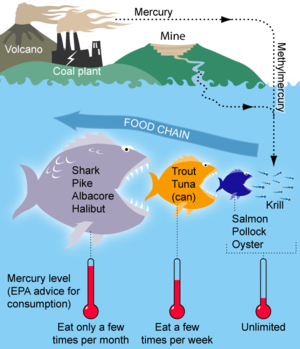
Mercury is a naturally occurring element in the environment.  It can also be released into the air through industrial pollution.  Mercury falls from the air and into lakes, streams and oceans, whereby it converts to methylmercury.  It is this form of mercury that can be harmful to unborn babies and young children.  Fish absorb environmental methylmercury as they feed, and thus it accumulates in their tissues.  However, this accumulation varies - some types of fish and shellfish are more susceptible depending on what they prey on, and the levels of methylmercury is variable in different environments.  

In general, larger species of fish (such as shark) that are long-lived and prey on larger varieties of fish tend to accumulate more mercury in their tissues, since they are on the top end of the food chain.  Shrimp are on the bottom of the food chain - they are smaller and feed on phytoplankton and zooplankton, and accumulate less methylmercury than their larger predators.  The figure below illustrates this point beautifully.


The most common way people in the US are exposed to mercury is by eating fish containing methylmercury.  Some fish may contain methylmercury at levels that may be a cause of concern.  Note that most people's blood mercury level is below the level associated with possible health effects (<5.8 µg/L of whole blood), and that considerations around mercury intake primarily affect the following groups:

  • women who might become pregnant
  • women who are pregnant
  • nursing mothers
  • young children


So - How to choose fish and canned tuna?
Avoid:

  • canned Albacore (also called white tuna in the US and Canada)
    • Albacore is a large variety of tuna and tends to accumulate higher levels of mercury than other tuna varieties
    • Beware of "chunk white" or "solid white" labels
  • Shark, Swordfish, King Mackerel, Tilefish, Marlin, Bluefin tuna
    • these are all large species of fish at the top of the food chain
Instead choose:

  • canned Light Tuna
    • most people mistake the "light" to mean "less caloric", "less dense", "less fatty", etc.  Light Tuna is primarily composed of a smaller species of tuna called Skipjack, but can include others such as Bigeye, Yellowfin, and Tongol, in “any combination".  These varieties are lower in mercury levels than Albacore and Bluefun as they are smaller and accumulate less mercury.  However, Yellowfin has come under fire as sometimes having higher levels of methylmercury than Skipjack - and there are no regulations on combination ratios.
  • shrimp, pollock, salmon, catfish, oysters, trout, anchovies, tilapia, haddock, lobster, crab, hake, butterfish
**the values noted in this table may not be entirely accurate (it is Wikipedia after all, which I do not consider a trusted source of information).  However, I included it as the trends of mercury levels across species of fish is valuable and nicely displayed as a continuum from highest to lowest levels.


What's the take-away?
MercuryFoodChain-01.png

  1. If concerned about mercury levels, do not eat Shark, Swordfish, Pike, King Mackerel, Marlin, Tilefish.
  2. Eat no more than 12 ounces (two average meals) a week of a variety of fish and shellfish that are lower in mercury.
  3. You can consider eating up to 6 ounces of Albacore tuna per week.
  4. Your body will excrete methylmercury, but the clearance is slow, with overall half-life (i.e. the time to excrete half of ingested amount) at 70-80 days.  This varies by tissue (and the numbers are sobering).  The body is exceptionally efficient at excreting mercury in lactating females.
  5. I watched a documentary once about the canned tuna industry in the US - they catch the tuna, gut and often cook it right on board (often twice) to rid the tuna of its "fishy" flavor and smell.  However, in this process, the omega 3's are removed and dumped into the ocean as the fish is cooked en route to land.  So if you're looking for some omega 3, the Pacific Northwest has a bunch floating around in it!  Also note that because of this process, canned tuna has variable amounts of omega 3, which is not consistent from can to can.  
  6. Check local advisories about the safety of fish caught by family and friends in your local lakes, rivers, and coastal areas.  If no advice is available, eat up to 6 ounces (one average meal) per week of fish you catch from local waters, but don't consume any other fish during that week.


Click here for EPA guidelines on mercury exposure.

Please see:
EPA-FDA Joint Federal Advisory for Mercury in Fish: “What You Need to Know About Mercury in Fish and Shellfish”: